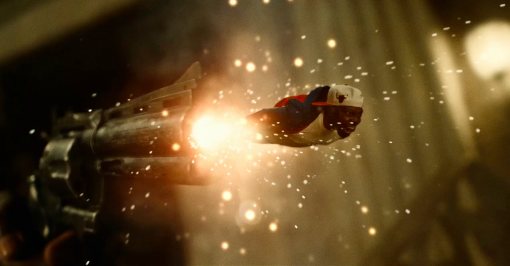
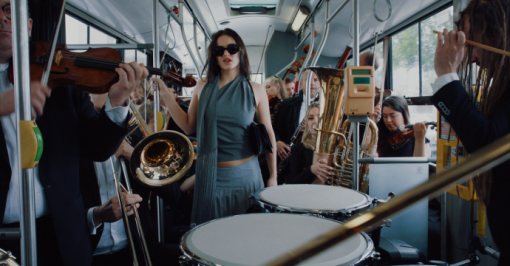
Thirty robot arms, a Budapest train station, and take 39
To get a reflection of a reflection of a reflection, two mirrors have to be perfectly parallel. Thirty-odd industrial robot arms held them there, synchronised not to a frame rate but to 78 beats per minute.
 Watch on YouTube
Most "how did they do that" videos have an answer that deflates the question. This one has an answer that makes it more interesting.
OK Go's "Love" is a single take shot in a nineteenth-century Budapest railway station using more than thirty Universal Robots arms, each carrying a mirror. Co-director Miguel Espada explains the idea plainly:
The main idea behind the video was to use mirrors to create different visual effects. The concept revolved around multiplying reflections as a metaphor for love.
Why it needed robots
Because the effect they wanted is physically unforgiving:
To achieve an infinite reflection, a reflection of a reflection of a reflection, it's enough to place one mirror in front of another. But if those two mirrors aren't perfectly parallel, the reflections curve and ruin the illusion… Achieving that level of precision with traditional analog methods wasn't viable.
A human grip cannot hold a mirror to that tolerance while moving. A robot arm can, repeatably, on every take.
The detail worth stealing
The synchronisation is the part that should interest anyone who has tried to cut picture to music. They did not animate the robots at a frame rate and hope it lined up:
We had to sync over 30 robots to the music with absolute precision… We reprogrammed our control software to work at the same BPM as the song. Normally, animations are run at 30, 50, or 100 frames per second, but in this case, we synced everything to 78 BPM.
The timeline's unit stopped being the frame and became the beat. Everything downstream of that decision falls into place, which is presumably why it worked at all.
Fortunately, everything came together on take 39.
Credits as published
Directors Damian Kulash, Aaron Duffy, Miguel Espada. Cinematographer Jordan Buck. Production designer Will Field. Choreographer Devin Ash-Quaynor. Robot animators Dani Kei V. Kaneda and Paula Charmes Jambrina. Robotics producer Francesca Palau. Executive producer Andrew Geller, producer Petra Ahmann. Stylist Stacey Berman. 1stAveMachine, April 2025.
It won Best Rock Video – International at the UKMVA 2025; Will Field was nominated for Best Production Design. Damian Kulash separately received the UKMVA Icon Award that year.
Missing a credit? Tell us who worked on this and we will add them and say that we did.